×
This product is available in Please select the desired country to continue
  • Půdní struktura
    crop soil texture
    Sand, loamy sand, boggy soil
  • Min. teplota
    crop temperature icon
    Germination from 5°C
  • pH
    Mrkev crop pH value
    Tolerant of slightly acidic to slightly alkaline soils; pH optimal: 6.5-7.5
  • Dešťové srážky
    Mrkev crop rainfall value
    Min. 600l/m2 mostly watered
  • Jarovizace
    Mrkev crop vernalisation
    14-28 days
  • Hustota porostu
    crop density
    Depending on date and sort 80-220 grains/m2
  • Hloubka setí
    crop seeding depth
    1.0-2.5cm
Carrots
Crop requirements: Only sieveable, well-settled soils are suitable, as stones and incompletely decomposed organic material reduce the quality of the carrots. A good and very even water supply is necessary, as waterlogging lowers the sugar content and increases the risk of soil-borne fungi. Carrots are watered regularly. Carrots need a wide, at least 5-7-year crop rotation, in which there should be no other umbelliferae (e.g. celery, fennel or parsnip). Very good prior crops are cabbages, onions and leek. In addition to the yield, the quality, which is, however, economically very important, is negatively affected by a too narrow crop rotation.
Klíčové informace
  • Pay attention to wide crop rotation!
  • A neutral pH is optimum
  • Large differences in nutrient requirements depending on harvest time, yield and direction of use
  • Use chloride-free or low-chloride fertilizer.
Všeobecné informace
Všeobecné informace
Potřeba živin
Potřeba živin
Hnojení
Hnojení
CARROTS - SWEET AND RICH IN CAROTENE AND VITAMINS
A deep plough furrow and milling prevents legged carrots. The soil must be very finely crumbly and well-deposited. The significance of cultivation on ridges is increasingly displacing cultivation in beds. Advantages of cultivation on ridges are better harvesting conditions and the improved quality, especially on heavy soils. During rainfall, the soil surface dries up faster, but in water-tight locations, this can quickly lead to a water shortage. The ridges are usually created at a distance of 50 or 75cm. The sowing time is from March to mid-June, depending on the region, variety, direction of use and harvest time. A distinction is made between the production targets of carrots as industrial goods, fresh market goods (often with cabbage) and stored goods. With fresh market goods or use of a top-lifting harvester, attention must also be paid to the health of the leaves. In controlled cold storage rooms, storage for up to 6 months is possible. The atmosphere in the warehouse is also very important, as a high CO2 or ethylene content in the air leads to bitter carrots.
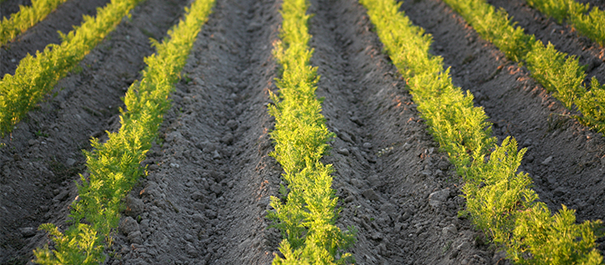
Mrkev related desktop image Mrkev related tablet image Mrkev related mobile image
Nutrient requirements of carrots vary according to production target
The high yields that can be achieved today with special qualities are only achieved with optimised, adapted fertilization, which takes into account the actual removal of nutrients. As with many other vegetable crops, there are very differentiated nutrient uptakes due to the different yields, production targets and culture duration (3-5 months). The nutrient return for the following crops strongly depends on whether the leafy part remains on the surface. In addition to the yield, the nutrient supply has a decisive influence on the quality, the ingredients and the taste of the carrots. Basically, carrots have a good ability to acquire nutrients, which is supported by intensive soil cultivation and a long cultivation time. Carrots are nutrient-consuming and need a lot of potash. In addition to the yield, potash also has a positive effect on the sugar content, shelf life and taste. As with all crops, the fertilization must also be based on the extraction quantities for carrots.
Extraction quantities for carrots

Element

Příjem

jednotka/t produkce

Odstranění

jednotka/t produkce

Citlivost na nedostatek

N

1.8

1.5

Velmi citlivé

P2O5

0.9

0.8

Citlivé

K2O

4.8

4.4

Velmi citlivé

MgO

0.4

0.3

Citlivé

TE

300-500 g/ha Bor (B)

The table shows uptake and removal per tonne of carrot yield (without leaves). According to this, carrots need mainly nitrogen and potash. Example: A carrot yield of 90t/ha takes up 162kg N/ha. If a certain amount of N replenishment is absorbed from the soil (for example 30kg N/ha), then 132kg N/ha would need to be added by means of fertilizer. From the harvested yields, 135kg N/ha would be extracted from the field.
Directly using organic fertilizer on carrots is not recommended, as unrotted organic material can cause quality problems and fresh manure or liquid manure tends to attract carrot flies.

First application

First application image

Second application

Second application image

First application

Basic fertilization with nitrogen, phosphorus, potash before sowing A nitrogen fertilization above 100kg/ha, should be divided into 2 applications. A basic fertilization then takes place before sowing and another ideally in the fourth to sixth week after sowing. Due to the high demand for potash, the use of concentrated potash-emphasized NPK-fertilizers has proven effective. Since carrots are sensitive to salt, care must be taken that these NPK formulas are chloride-free or low in chloride. The best time for a basic fertilization is about 2 weeks before sowing. With the use of selected complex fertilizers, the magnesium requirement is also covered. The chlorophyll content can be positively influenced by sufficient magnesium. A good supply of magnesium is also necessary for the health of the leaves. The health of the leaves is particularly important in fresh market product, which also requires magnesium for an intensive green colour. When using a top-lifting harvester, crop loss can be minimised by a healthy leaf.

Second application

Nitrogen and potash supplementation The second dose is applied based on the N-min value. The date of the second nitrogen dose should not be chosen too late, otherwise the coloring of the carrots is delayed, the shelf life is impaired and an unnecessarily large leaf mass develops. For a single dose of nitrogen, the second date is the better choice. Since the potash requirement of carrots is very high, potassium should also be given in the second dose. Potassium is necessary for the formation of sugar content and flavour, as well as yield and storability. Good potassium uptake also reduces the type of stress caused by excess or insufficient water. Boron as a liquid fertilizer Boron is often described as necessary for strengthening carrots against fungal diseases. A poor supply of boron can lead to small tissue cracks, especially at the head of the carrot. These cracks often serve as entry ports for fungal infections. Boron thus indirectly helps to reduce fungal diseases.